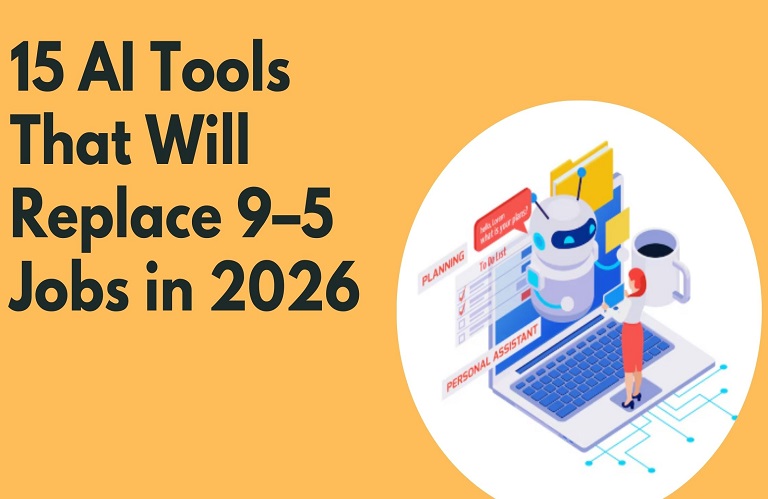
Artificial intelligence is rapidly transforming how businesses operate. Tasks that once required hours of human effort can now be completed in minutes using advanced automation platforms.
In 2026, AI tools are not just assisting workers — they are redefining entire job roles.
From content creation and coding to customer support and marketing analysis, modern AI tools 2026 are capable of handling complex workflows with impressive efficiency.
This shift does not necessarily mean that jobs will disappear completely. Instead, it signals a transition where professionals must adapt and learn how to collaborate with automation tools and productivity AI to remain competitive.
Let’s explore the 15 AI tools that are reshaping work and replacing many traditional 9–5 tasks.
Why AI Tools Are Changing the Workplace
AI-driven platforms are designed to automate repetitive tasks, analyze large datasets, and generate insights quickly.
Companies increasingly rely on these technologies because they offer:
• Faster decision-making
• Reduced operational costs
• Improved productivity
• Scalable automation
This shift is part of a broader technological transformation where AI replacing jobs is becoming a major conversation across industries.
According to global research from McKinsey on automation and the future of work, artificial intelligence could automate many routine tasks currently performed by humans.
External source:
https://www.mckinsey.com/mgi/our-research/the-future-of-work-after-covid-19
1. ChatGPT
ChatGPT has become one of the most widely used productivity AI tools for writing, research, coding assistance, and brainstorming.
Professionals use it for:
• Content writing
• Email drafting
• Research summaries
• Coding support
The growing influence of conversational AI platforms is explored in our article discussing ChatGPT vs Google search models, where AI-driven answers are reshaping how people access information.
Website:
https://openai.com/chatgpt
2. Jasper AI
Jasper AI is designed specifically for marketing teams and content creators.
It helps automate:
• Blog writing
• Marketing copy
• Social media captions
• Product descriptions
This makes it a powerful solution for businesses looking to scale content production.
Website:
https://www.jasper.ai
3. Midjourney
Midjourney generates high-quality images from simple text prompts.
Graphic designers, marketers, and creators use it to produce:
• Marketing visuals
• Concept art
• Social media graphics
AI image generation is rapidly transforming creative industries.
Website:
https://www.midjourney.com
4. Runway AI
Runway AI allows users to create and edit videos using artificial intelligence.
It can:
• Generate videos from text
• Remove backgrounds automatically
• Create visual effects
This tool significantly reduces the time required for video production.
Website:
https://runwayml.com
5. Copy.ai
Copy.ai helps businesses automate marketing content.
It is widely used for:
• Email marketing
• Ad copy
• Website text
• Sales messaging
Automation tools like this are increasingly used to replace repetitive marketing tasks.
Website:
https://www.copy.ai
6. Notion AI
Notion AI enhances productivity by integrating AI directly into workspace management.
It helps teams:
• Summarize documents
• Generate reports
• Organize project workflows
This makes it one of the most useful productivity AI tools for remote teams.
Website:
https://www.notion.so
7. Grammarly AI
Grammarly has evolved into a powerful writing assistant capable of rewriting, editing, and improving professional communication.
It helps automate:
• Grammar correction
• Tone adjustments
• Content clarity
Website:
https://www.grammarly.com
8. GitHub Copilot
GitHub Copilot uses AI to assist developers in writing code faster.
It can:
• Suggest code snippets
• Generate functions
• Identify errors
For software developers, this tool significantly increases coding productivity.
Website:
https://github.com/features/copilot
9. Synthesia
Synthesia allows businesses to create AI-generated videos with virtual presenters.
Companies use it for:
• Training videos
• Product tutorials
• Corporate presentations
Website:
https://www.synthesia.io
10. Zapier AI
Zapier automates workflows between different applications.
It can automatically connect tasks such as:
• Sending emails
• Updating spreadsheets
• Managing CRM systems
This makes it one of the most practical automation tools for businesses.
Website:
https://zapier.com
11. Canva AI
Canva now includes AI-powered features that generate designs, presentations, and visual content automatically.
It simplifies design processes for marketers and entrepreneurs.
Website:
https://www.canva.com
12. Descript
Descript is an AI-powered audio and video editing platform.
It can:
• Edit audio by editing text
• Remove filler words
• Generate voice clones
This tool is widely used by podcasters and video creators.
Website:
https://www.descript.com
13. Pictory
Pictory transforms written content into short videos automatically.
It is commonly used for:
• Social media video creation
• Marketing content
• Educational videos
Website:
https://pictory.ai
14. Surfer SEO
Surfer SEO helps marketers optimize content for search engines using AI-powered analysis.
It analyzes:
• Keyword usage
• Content structure
• Competitor pages
Tools like this are often included among the best SEO tools used by marketers to improve search visibility.
Website:
https://surferseo.com
15. Fireflies AI
Fireflies AI automatically records, transcribes, and summarizes meetings.
It helps businesses save time by turning conversations into searchable notes.
Website:
https://fireflies.ai
How AI Tools Are Changing Careers
The rise of AI tools 2026 highlights a shift toward automation and digital productivity.
Rather than eliminating all jobs, AI is reshaping how work is performed.
Many professionals now focus on:
• Strategy
• Creative problem solving
• Decision-making
• Managing AI-powered workflows
Routine tasks are increasingly handled by automation tools, allowing humans to focus on higher-value activities.
The Future of AI and Work
Artificial intelligence will continue transforming industries over the next decade.
We are already seeing AI influence areas such as:
• Marketing
•Software development
• Customer service
• research
• Education
As discussed in our analysis of the future of SEO and AI-driven search, AI technologies are not only changing workplaces but also reshaping how people search for information and interact with digital platforms.
Businesses that adopt productivity AI tools early will gain a competitive advantage.
Final Thoughts
The rise of AI tools 2026 signals a major shift in how modern work operates.
From content creation and marketing automation to coding assistance and design generation, AI platforms are rapidly improving productivity across industries.
While some routine tasks may disappear, new opportunities will emerge for professionals who learn how to leverage automation tools and productivity AI effectively.
Rather than fearing AI replacing jobs, the smartest approach is to embrace these technologies and adapt to the changing future of work.
About the Author